

Key Specifications & Features
-
Displacement: 3.9 liters (3856 cc)
-
Configuration: Inline-4 Cylinder, OHV (Overhead Valve)
-
Aspiration: Naturally Aspirated
-
Fuel System: Direct Injection with a mechanical inline injection pump.
-
Power Output: Approximately 100 horsepower (75 kW) – varies slightly by year and application.
-
Torque Output: Approximately 230 Nm (170 lb-ft)
Key Design Features:
-
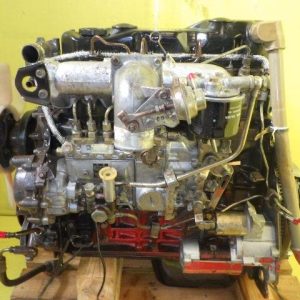
Mechanical Inline Injection Pump: This is the heart of its reliability. It’s a purely mechanical, gear-driven pump with no electronics. It is simple to repair, calibrate, and is incredibly tolerant of varying fuel qualities.
-
Direct Injection (DI): Fuel is injected directly into the combustion chamber. This is more thermally efficient and fuel-efficient than the indirect injection (IDI) used in contemporaries like the Toyota B and L engines. However, it makes the engine significantly noisier, producing the characteristic diesel “clatter.”
-
Overhead Valves (Pushrod Design): A simple, robust, and compact design. While not as high-revving as an OHC engine, it is incredibly durable and produces excellent low-end torque.
-
Naturally Aspirated: No turbocharger. This means fewer parts to fail, but also limits power and performance, especially at altitude or under heavy load.
Strengths of the Isuzu 4BC2
This engine is loved for reasons that are increasingly rare in modern engines:
-
Legendary, Near-Unbreakable Reliability: This is its defining characteristic. The 4BC2 is famously overbuilt. Its internal components (crankshaft, connecting rods, block) are massively strong for its output. With basic maintenance, it is common to see these engines exceed 500,000 miles and even reach 1,000,000 km.
-
Simplicity and Ease of Repair: There are no computers, no sensors, no electronic control units. Any competent diesel mechanic can fix anything on this engine with basic tools. Parts are generally inexpensive and widely available globally.
-
Excellent Low-End Torque: The combination of direct injection and its design gives it strong pulling power at low RPMs. This made it ideal for stop-and-start city delivery work.
-
Fuel Tolerance: The mechanical injection pump and robust fuel system are far more forgiving of poor-quality or contaminated diesel than modern high-pressure common-rail systems.
-
Global Parts Availability: Due to its use in millions of trucks worldwide, finding parts is rarely a problem.


Reviews
There are no reviews yet.